How to write content that AI assistants cite
The pages ChatGPT, Claude, Perplexity and AI Overviews cited in our study had a shape: article-like, direct, specific and longer than what ranked. A page template any business can use, built from those measurements.

Most AI SEO advice about content is a vibe: "write authoritative content," "be helpful." We wanted something more specific, so we looked at what the cited pages in our September 2026 study had in common, against pages that ranked on Google for the same question and were never cited.
Here's the shape, and a template you can use for any business.
What the cited pages looked like
Article-shaped. 41.6% of cited pages carried Article or BlogPosting markup. None of the pages that ranked without being cited did. Within companies' own sites, assistants reached for blog posts and guides, while the product and pricing pages ranked and got passed over.
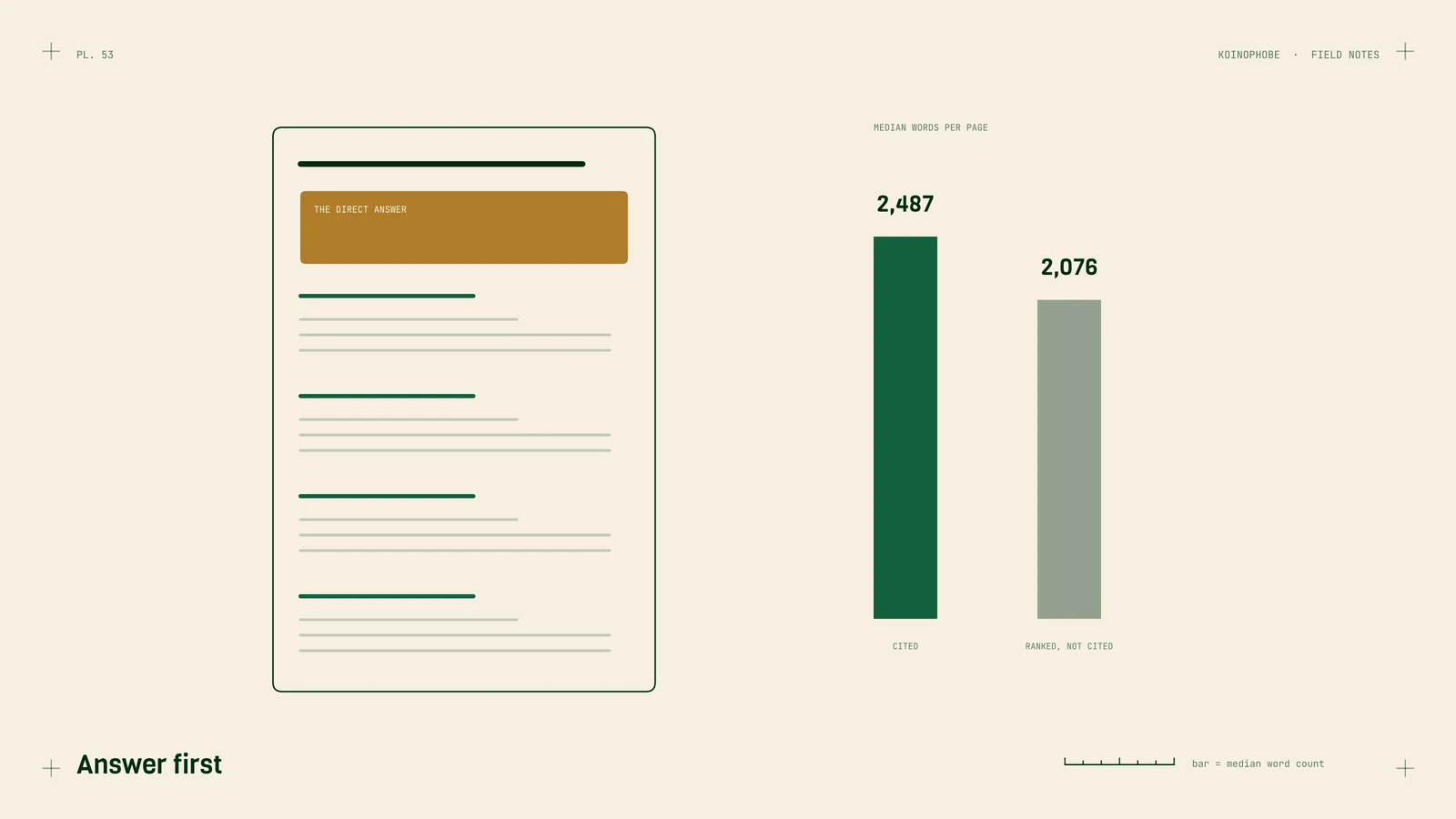
Longer, a bit. Median 2,487 words for cited pages against 2,076 for the comparison group. That's descriptive, with no interval computed, so treat it as a hint. Length follows from covering a question fully, not the other way round.
More specific. Cited pages named a median of two vendors against one. They compared and qualified instead of describing one product in isolation.
Mostly vendor-written. 71.5% of cited pages were vendor-owned. Assistants didn't shut out companies writing about their own field. They cited the ones that wrote useful articles.

A template that matches
This is the structure we use for client pages meant to be cited. It works for a roofer's cost guide, a remodeler's comparison or a plumber's explainer.
1. A title that is the question, or answers it. "How much does a metal roof cost in Florida in 2026?" or "Invoice software for agencies: five options compared."
2. A direct answer in the first two or three sentences. The number, the recommendation, the yes or no, with the main condition. If a reader stops here, they got their answer. If a system lifts one passage, this is it.
3. Headings phrased as the follow-up questions. "What makes it more expensive?" "How long does it last?" "Does insurance cover it?" Google's AI features run related searches across subtopics, and each heading is a chance to match one. More on that.
4. Facts with dates and sources. "Prices checked October 2026." "Florida Building Code requires..." "According to the manufacturer's spec sheet..." Dated, sourced facts are easier to trust and to quote.
5. Your own experience. What you've seen on real jobs or with real customers. This is the part a competitor's AI-written page can't copy, and it's what makes a page worth citing over the other forty.
6. Where the alternative wins. A page that only praises your option reads as an ad. Name the cases where someone should pick something else.
7. A named author with a bio. And Article or BlogPosting markup with author, datePublished and dateModified. Schema for AI search covers the markup.
8. Links to related pages. Each guide links to the service it supports and to neighboring questions. Internal links help crawlers find the cluster.
What to write about first
Start with the questions where assistants already name competitors and not you. Ask ChatGPT, Claude, Perplexity and Google your customers' questions, note who's cited, and write the better page. Our tracking method makes that list.
Good first pages for most businesses:
- Cost pages. "How much does X cost" is asked constantly and rarely answered honestly.
- Comparisons. You versus the main alternative, or two options customers weigh. Head-to-head questions drew on the fewest sources in our study, so each cited page gets a bigger share. Comparison pages.
- "Is it worth it" pages. Decisions with trade-offs, answered plainly.
Mistakes we see
- Answer buried in paragraph six. Move it to the top.
- Prices in images, tables as screenshots. Google advises keeping important content in text. So do we.
- Undated pages. Assistants repeat stale facts. Date yours and update them.
- AI-written filler. Forty pages that say the same thing as every other site give an assistant no reason to pick yours.
Next steps
Pick one question your customers ask before buying, and rewrite or write that page using the template above this week. Then check it can be read: run the free AI crawler check.
If you want a steady supply, our AI search optimization service writes 12 in-depth pages a month in this shape, plus the fixes and tracking. $1,000 a month, no contract.
Frequently asked questions
What kind of content do AI assistants cite?
In our September 2026 study, cited pages were mostly article-shaped: guides, comparisons and roundups. 41.6% carried Article markup against none of the pages that ranked on Google and weren't cited. Product and pricing pages ranked but were rarely cited.
How long should content be to get cited by AI?
There's no magic length. Cited pages in our study had a median of about 2,500 words against about 2,100 for pages that ranked and weren't cited, but that was descriptive, not a tested cause. Write as long as the question needs and put the direct answer first.
Should I write content for AI or for people?
For people, in a shape machines can lift. A direct answer in the first lines, clear headings phrased as questions, facts with dates and a named author help a reader and a system at the same time.