Generative engine optimization (GEO): what it is and what holds up
GEO is the name for getting your business into answers from ChatGPT, Claude, Perplexity and Google's AI Overviews. What the term means, which GEO advice our own measurements support, and which they don't.

Generative engine optimization, GEO for short, is the name that stuck for getting your business into answers written by AI: ChatGPT, Claude, Perplexity, Gemini, Copilot and Google's AI Overviews. You'll also hear AEO (answer engine optimization), AI SEO, and LLM SEO. They point at the same goal, and we compare them in GEO vs SEO vs AEO.
The term comes from a 2023 academic paper titled "GEO: Generative Engine Optimization." It spread fast because business owners noticed customers asking assistants instead of searching. The advice spread faster than the evidence. This note sorts the two.
What GEO is trying to change
An AI answer has two parts a business can care about:
- The mention. Your company is named in the text: "Good options include Acme Plumbing and..."
- The citation. One of your pages is linked as a source.
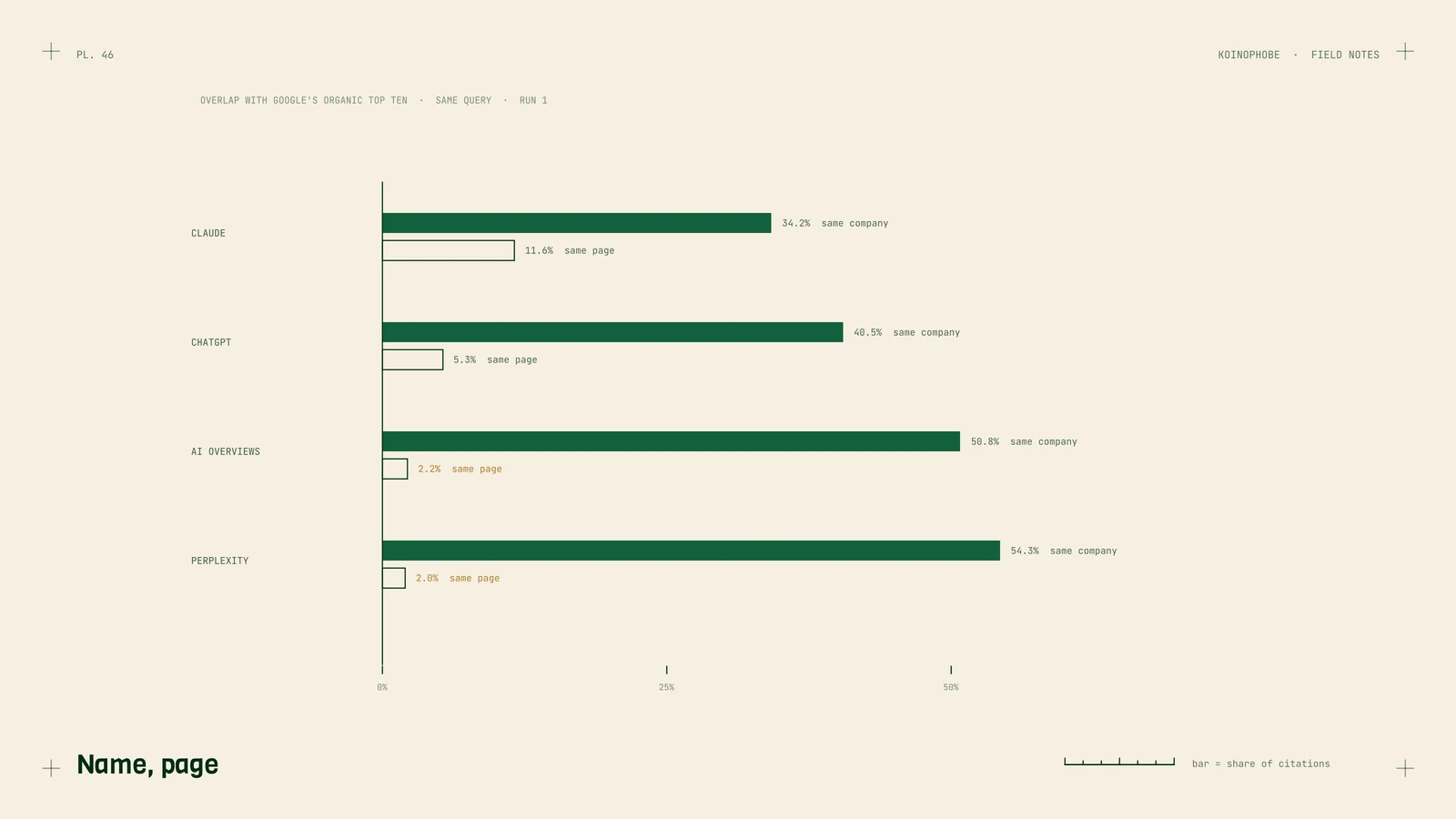
In our September 2026 study, those two behaved very differently. Assistants named the same companies Google ranked 34% to 54% of the time, but cited the same pages only 2% to 12% of the time. So GEO has two jobs that need different work: being a company the web recognizes, and having pages assistants choose to quote.
GEO advice that holds up
Let the right crawlers in. If OAI-SearchBot, Claude-SearchBot or PerplexityBot can't fetch your pages, nothing else matters. OpenAI says this directly for ChatGPT search. It's the one GEO step that works by definition, and the most common one we find broken. How to check.
Rank on Google for the questions buyers ask. The company overlap above is the strongest pattern in our data. Google-ranked companies are the pool assistants pick from.
Publish article-shaped pages. 41.6% of the pages assistants cited carried Article markup, against none of the pages that ranked and were never cited. The markup is a trace of the page type: guides, comparisons and roundups get cited, product pages mostly don't. Content that AI cites goes deeper.
Get talked about elsewhere. Google's AI Overviews pulled 20.1% of its citations from forums and social sites in our study, and 14.6% from independent roundups. Being discussed off your own site is part of the job. See Reddit and AI search.
GEO advice our data doesn't support
"Add structured data to get cited." Having any structured data at all didn't separate cited pages from pages that ranked and were never cited: 74.3% against 83.3%, inside the noise and pointing the wrong way.
"Make it server-rendered and fast and you'll be cited." Server-rendering matters for being read at all, but it didn't separate the groups either, because nearly everything that ranks is already server-rendered.
"Add an llms.txt file." Google said in 2025 that no AI system currently uses it. More here.
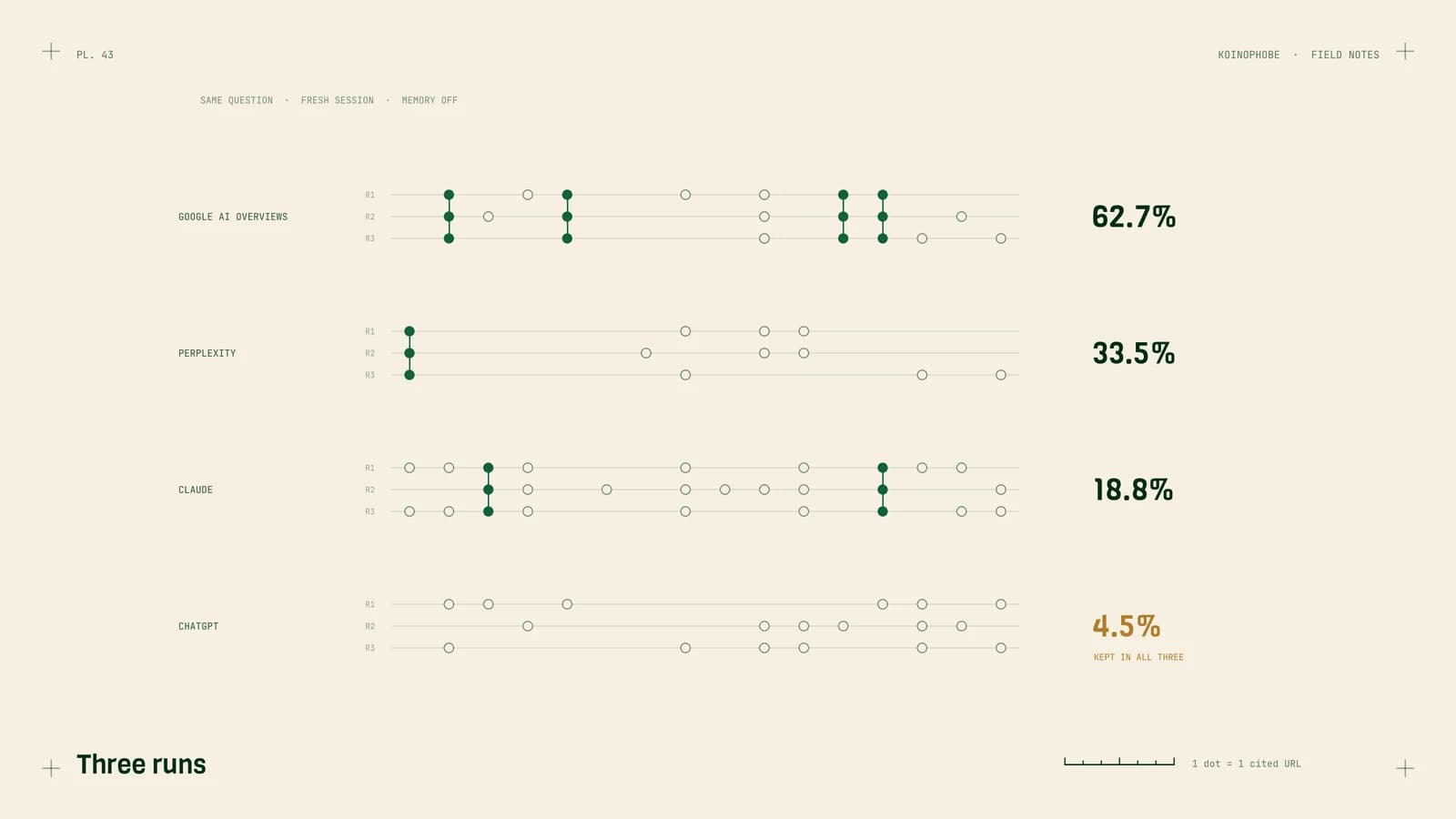
"We'll get you into ChatGPT in 30 days." Asked the same question three times, ChatGPT kept 4.5% of its cited pages. Google's AI Overviews kept 62.7%. A channel that moves that much can't be promised.
How to measure GEO without fooling yourself
Freeze a list of 10 to 20 buyer questions. Ask them across several assistants, in fresh sessions, more than once for the ones that matter. Count how often you're named and how often you're linked. Compare month to month on the same list. That's the method from our study, scaled down, and we wrote it up as how to track AI search visibility.
If an agency's GEO report is one screenshot per question, it's measuring luck.
Where GEO fits for a business owner
For most businesses, GEO is SEO with two additions: checking crawler access for AI bots, and measuring the answers directly. The pages that win on Google and the pages that get cited are both built on clear, useful content about real questions. Is SEO dead? No. It's the foundation GEO stands on.
Next steps
Start with the part that works by definition: run the free AI crawler check. Then read how to rank in ChatGPT for the month-one plan.
If you want GEO done with the measurement attached, our AI search optimization service runs the full loop every month: access fixes, tracking with repeated runs, and the pages. $1,000 a month, no contract.
Frequently asked questions
What is generative engine optimization?
Generative engine optimization, or GEO, is the work of getting your business named and linked in answers written by AI assistants such as ChatGPT, Claude, Perplexity and Google's AI Overviews. The term comes from a 2023 research paper titled "GEO: Generative Engine Optimization."
Is GEO different from SEO?
It overlaps heavily. AI assistants still need to crawl your pages, and in our September 2026 study between 34% and 54% of the companies they cited also ranked in Google's top ten. GEO adds measuring the answers themselves and building pages that assistants choose to quote.
Does GEO work?
Some of it is measurable and some isn't. Making sure AI crawlers can read your site works by definition. Claims that a specific page tweak gets you cited are mostly untested, and answers change so much between runs that a single before-and-after screenshot proves nothing.