A seasonal marketing calendar for home services: publish before the rush
A seasonal marketing calendar for home services: what roofers, HVAC, lawn and pool companies should publish each month so pages rank before the busy season.

A hurricane shutter company we work with got 37 of its 51 clicks in one 28-day window from a single article, a seasonal piece on hurricane history. One page brought in most of the site's search clicks in that window.
Home service demand comes in waves. AC repair in summer, furnaces in winter, lawn programs in spring, storm work when the weather turns. The page that catches a wave has to be indexed and ranking before it arrives, and that takes time. Movers and cleaning companies ride the same waves: moving season peaks in summer, and move-out cleaning follows it. Moving company SEO covers the timing for movers.
Why publishing in season is too late
A new page has to be crawled, indexed and tested against the pages already ranking. That can take weeks or months, and we can't tell you which for any given site. If you publish an AC repair page in July, it may settle into its position in September, when the calls have slowed.
So plan at least one season ahead. Write summer pages in winter and winter pages in summer.
The busy seasons by trade
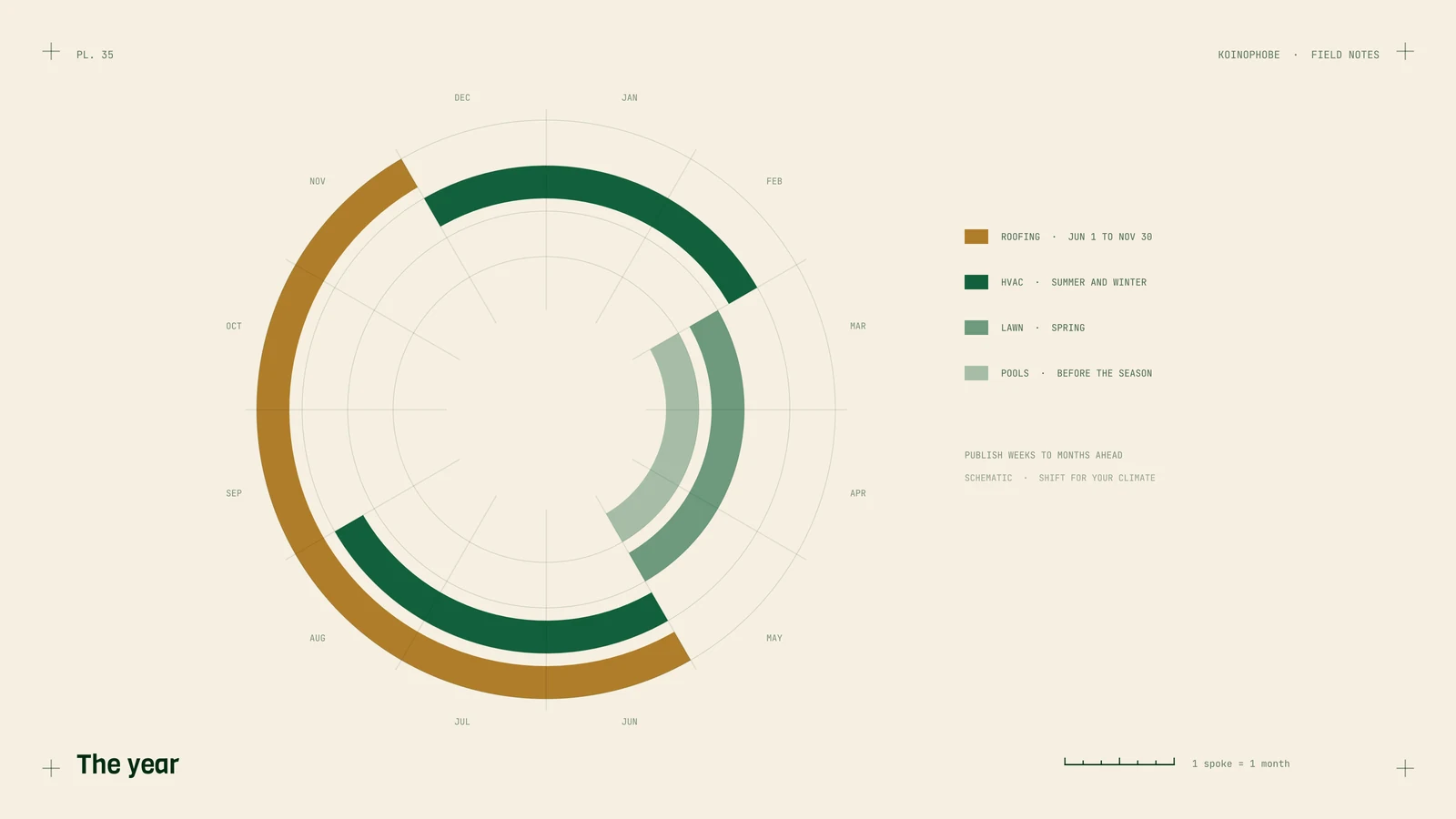
- Roofing: storm season. On the Atlantic and Gulf coasts that means hurricane season, June 1 to November 30, with the peak around September 10. Inland, hail and wind seasons vary by region.
- HVAC: cooling in summer, heating in winter, and tune-up work in the shoulder months between.
- Lawn care: spring, when homeowners sign up for programs and first cuts.
- Pools: the weeks before pool season, when owners book openings and repairs.
Your climate shifts all of these. A Florida pool company and a Massachusetts one run on different calendars, so shift the table below to fit yours.
Month by month
| Month | Publish or refresh |
|---|---|
| January | Spring lawn program pages, pool opening and resurfacing pages |
| February | AC tune-up and AC repair pages, lawn fertilization pages |
| March | Hurricane prep articles for coastal roofers and shutter companies, roof inspection pages |
| April | Storm damage and insurance claim pages, refresh last year's hurricane articles |
| May | Final checks on storm pages, summer HVAC questions, pool repair pages |
| June | Furnace and heating pages for fall, fall lawn aeration and overseeding pages |
| July | Furnace tune-up and heat pump pages, refresh storm damage pages |
| August | Leaf cleanup and fall lawn pages, pool closing pages |
| September | Post-storm repair pages ready to go, winter HVAC questions |
| October | Review the season in Search Console, plan next spring's pages |
| November | Spring pool and lawn outlines, update any dated titles for next year |
| December | Write next year's AC pages and spring service pages |

The pattern is the same in every row: the page goes live a few months before its searches peak.
Refresh what already ranks
Last year's seasonal pages are a head start if they already show up in search. Before each season, open the Performance report in Google Search Console and compare the same months last year. Look at which queries each seasonal page showed for, then update the page with this year's photos, dates and any new questions. Keep the same URL. Our Search Console guide for contractors shows where those comparisons live.
What the shutter article tells us
The 37 of 51 figure shows where that site's clicks came from in that window: one seasonal article. On the same site, searches for a neighboring town climbed into the top three and still got nothing. 19 of those searches ranked in the top five, with 691 impressions and zero clicks. In that window, the seasonal article got the clicks and the town searches got none.
On a Florida roofing site we work on, long-form articles on the questions homeowners ask after storms were one part of the work, alongside title rewrites, a service page per town and schema. Average position went from 47.9 to 14.9 across October 2025 to August 2026, compared with the eleven months before. We can't credit the articles alone for that, but they're the part that answers storm-season searches. The page types are in storm damage roofing pages.
Trade notes
Each trade has its own seasonal pages worth planning:
- HVAC: what an HVAC site needs
- Lawn: lawn care SEO
- Pools: pool deck repair SEO
Turn the calendar into a schedule
Pick your trade's busy months, count back three to four months, and put a publish date on the calendar for each page. Two pages a month gives you 24 by this time next year.
That's the pace on our Growth plan: 2 new town or service pages a month, plus Business Profile posts and a monthly call. Details are on the pricing page.
Frequently asked questions
How far ahead should I publish seasonal content?
At least one season ahead. New pages can take weeks to months to rank, so a page published when the busy season starts often shows up after the demand has passed.
When should roofers publish hurricane season content?
Before June 1, when the Atlantic hurricane season starts. It runs to November 30 and peaks around September 10, so storm prep and damage pages should be live and indexed by late spring.
Should I update old seasonal pages or write new ones?
Update the page that already ranks and keep its URL, so it keeps what it has earned. Write a new page when the topic is new.